




 Bestselling Author Freida McFadden Reveals Her True Identity






12 min read


Did 300 rabbis in the 13th century abandon Europe for a war-torn Holy Land? Who were they and what happened to them?
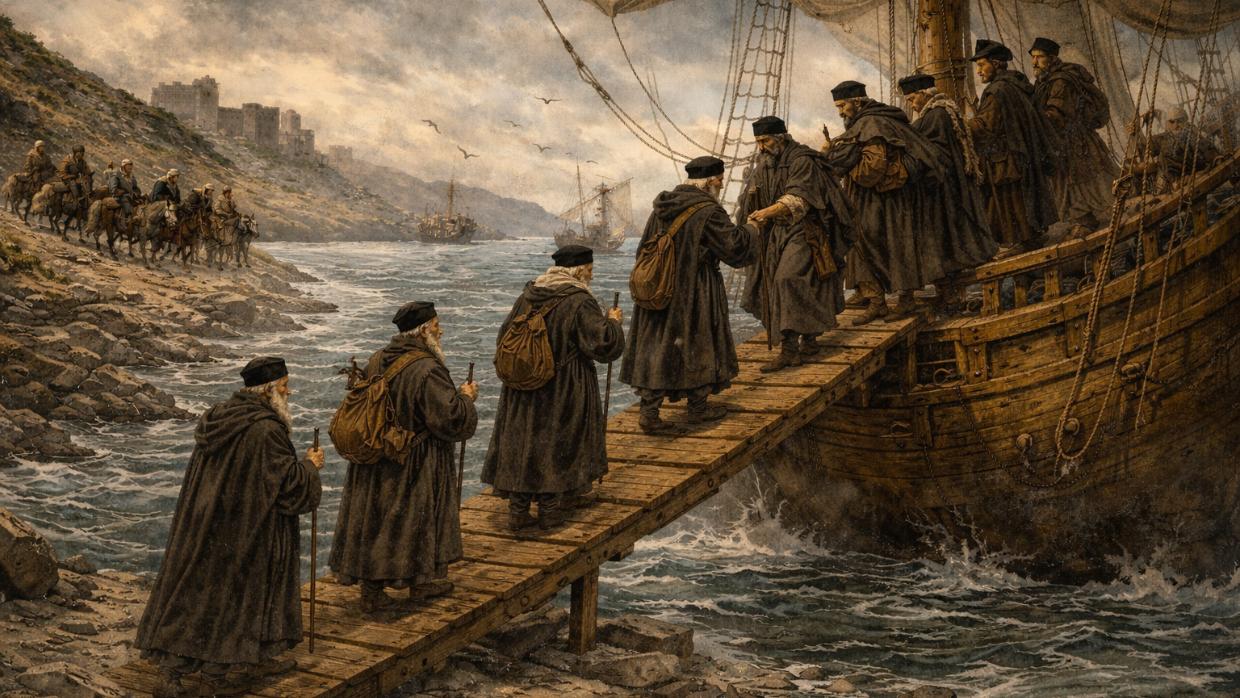
There is a little-known, multilayered mystery at the heart of the Middle Ages. Around 1211 CE, as many as 300 rabbis suddenly uprooted themselves simultaneously from different regions in Europe and made their way to the Land of Israel.
Why? What motivated them to undertake the dangerous journey?
Who were these rabbis? And most puzzling of all: What became of them?
While information about the aliyah of the 300 rabbis is sparse, we’ll attempt to find some answers by drawing on tantalizing literary references and looking at the relevant historical context.
There is a general consensus among scholars that there was a surge of Jewish immigrants to the Land of Israel in the early 13th century. It most likely took place in two waves – from Provence and then from northern France, England and possibly elsewhere in Western Europe.
“We arrived at Jerusalem by the western end of the city, rending our garments on beholding it, as it has been ordained we should do. It was a moment of tender emotion and we wept bitterly....” So wrote Rabbi Shmuel ben Shimshon in a detailed letter to his father and their community back in France, describing his journey to and within the land of Israel in 1210 CE. He was part of a group of four European rabbis who made their way to Israel via Egypt, led by the renowned Provençal scholar Rabbi Yonatan of Lunel.
There is some evidence that their travels became well known and inspired many more French (and English) Jews to make aliyah. In fact, Rabbi Shmuel concludes his report by saying that he carried a letter from the King of Jerusalem, John de Brienne, that provided him safe passage and also recommended the immigration of Jews to the Land of Israel.
Another key piece of contemporaneous evidence comes from Rabbi Avraham Maimuni (1186-1237), son of the great Maimonides (Rambam) and a leader of the Egyptian Jewish community. In HaMaspik le’Ovdei HaShem, a Judeo-Arabic text most likely completed by the 1220s CE, Rabbi Avraham refers to “sages of France” who would periodically pass through his community in Fustat (Old Cairo). References can also be found in responsa he drafted for his local community and in a book he wrote in defense of his father’s philosophical works (Milchamot HaShem).
A more lyrical description of the French rabbis who made aliyah was penned by Rabbi Yehuda ben Shlomo Al-Harizi (1160-1225). In his most well-known work, Tachkemoni, the Andalusian scholar and poet describes his visit to Jerusalem in the year 1216 CE in Hebrew rhymed prose.
Among the rabbis he met there, he writes, were those “who came from the land of France to dwell in Zion. …They who left their land and their birthplace, abandoned their inheritances, and set their hearts toward Jerusalem. And they did not concern themselves with their wealth or their honor, ‘and they forsook palaces of kings’ and houses filled with every good thing, in order to dwell within a barren and destroyed Jerusalem, and to visit the Holy Sanctuary, which lies in desolation and ruin.”
The 16th-century chronicle Shevet Yehuda, by the Inquisition-era refugee Rabbi Dr. Shlomo Ibn Verga, is the earliest source we have for the total number of rabbis who moved from Europe to the Land of Israel in the early 13th century. He writes, in part, “In the year 4971 (1210-11 CE), God inspired the rabbis of France and the rabbis of England to go to Jerusalem, and they numbered more than three hundred. The king honored them greatly, and they built synagogues and study halls there.”
That figure cannot be confirmed and many historians consider it an exaggeration or a traditional literary device rather than a literal count. The Talmud and Midrashic literature (indeed, many ancient Near Eastern texts) sometimes use large round numbers such as 300 to emphasize abundance, magnitude or importance. Ibn Verga may therefore have been intentionally signaling to his more Jewishly educated readers how momentous the event was, not how many took part. In fact, such a drastic spike in rabbis making aliyah in such a short period would have decimated the Torah centers of Western Europe at the time.
Such a drastic spike in rabbis making aliyah in such a short period would have decimated the Torah centers of Western Europe.
However, references in Medieval rabbinical works to leading scholars who moved to the Land of Israel suggest a possible alternative conclusion. The number “300” may be a conflation of ten or so relatively well-known rabbis, their families, several of their students, and other European Jews who made the move over the course of a decade in the early 13th century.
The long, arduous, and potentially dangerous journey Jews undertook from Europe to Israel in the Middle Ages speaks volumes about their intention and dedication.
The long, arduous, and potentially dangerous journey Jews undertook from Europe to Israel in the Middle Ages speaks volumes about their intention and dedication.
They traveled by sea and overland, on ill-kept roads, through various types of challenging weather, across a patchwork of borders, and at constant risk of falling prey to bandits. The trek itself could take two to four months, depending on the point of departure, travel conditions and the number of port calls along the way.
The most common route for Europeans was a sea voyage directly to the port city of Acco (Acre), which served as the political center of the Crusader Kingdom of Jerusalem at the time. However, historical records and personal letters indicate that most Jews chose to travel by way of Egypt, where they secured necessary permissions from regional Muslim rulers, connected with the local Jewish community and took advantage of its links with Jews in Israel. From Egypt, those travelers could reach their ultimate destination by sea, with a relatively short trip to a port on the coast, or overland for up to three weeks along an ancient caravan road through the Sinai Peninsula.
Jews of 13th-century Europe were still living in the shadow of the deadly Rhineland massacres that accompanied the Second Crusade just 60 years earlier and under the ongoing threat of sporadic outbursts of mob violence. These were often the result of blood libels and similar accusations, which also led to legal and financial repercussions.
Though targeted by growing hostility and restrictions led by the Roman Catholic Church, Jews were generally considered servi camerae regis (“servants of the royal treasury”). That means they were theoretically protected by the king, on the one hand, and taxed heavily on the other. Nonetheless, conditions were not uniform throughout Europe. Jews in northern France and England, for example, faced antisemitic measures that included localized, temporary and often economically motivated expulsions.
The precarious situation of many Western European Jews in the early 1200s surely played a role in motivating emigration. However, the more pious and leading religious thinkers of the day may have been inspired to move to the land of Israel by a deeply felt connection with the Jewish homeland, increased contact with Levantine Jewish communities, and a commitment to Torah values. Another possible undercurrent was a renewed Messianic expectation awakened by the impending turn of the millennium on the Jewish calendar (the year 5000) at the end of 1239 CE and geopolitical upheavals in the Holy Land.
Picture a high-stakes struggle between two of history’s most famous generals: Richard the Lionheart and Saladin. That was the situation at the end of the 12th century, as the Third Crusade engaged the Caliphate in war for control of the Land of Israel.
Though the port cities of Acre and Jaffa quickly fell to the Crusaders, Jerusalem remained a harder nut to crack and a stalemate ensued. Exhausted and respecting one another deeply, Saladin and King Richard I negotiated the Treaty of Jaffa. Broadly speaking, the Crusaders kept most of the coastal areas, while the city of Jerusalem and much of the interior remained under control of the Ayyubid dynasty. The situation was complicated, however, by semi-independent tribes, local emirates and lordships that acted autonomously and often clashed with other powers in the region.
It was into this complex and tense standoff that the European rabbis and their families entered at the start of the 13th century.
In his travelogue, Rabbi Shmuel details the feasibility of movement across the land of Israel, the size and nature of its Jewish communities, and the state of venerated ancient tombs throughout the country. He describes the Jews he encountered as poor, devout, often numbering only a few families in each location, and subject to heavy taxation.
Among the main Jewish centers Rabbi Shmuel and his colleagues visited were:
In the early 13th century, the land of Israel was a relatively difficult place to live. There were periodic Crusader–Ayyubid clashes, burdensome taxes, famine and disease. And yet, we have no record of a notable return to Europe by the Medieval Jewish immigrants. No letters to that effect, no travelogues, no diary entries, and no responsa.
Some of them remained in the port city of Acre, perhaps to maintain contact with European travelers, and others chose to settle in Jerusalem. They initially had a notable impact on Jewish life in the Holy Land, and beyond, but subsequent upheavals devastated their communities.
In 1229 CE, Ayyubid Sultan Muhammad al‑Kamil agreed to cede control of Jerusalem to Christian rule. For both Jews and Muslims in the city, this meant immediate and mass expulsion. Within just 15 years, however, the tables turned once again with the sacking of Jerusalem by the Turkic‑Persian Khwarazmian mercenaries. Hired by the Ayyubids, they massacred the Christian population and destroyed every vestige of a European or Christian presence. Though local Jews and Muslims could now return, the city was left ruined, impoverished, very sparsely populated and unsafe.
One of the most famous and poignant accounts of this period comes from the Spanish Jewish scholar Nahmanides (Rabbi Moses ben Nahman). During a visit to the Land of Israel in 1267, he wrote: “What shall I say of this land? ...The more holy the place, the greater its desolation. Jerusalem is more desolate than the rest of the country, and Judea more than Galilee. But even in its destruction, it is a blessed land.”
The key Crusader city of Acre, home to the largest and most stable local Jewish community at the time, fell to Muslim forces in 1291 CE. After a brutal siege, the Christian and Jewish populations were killed or expelled en masse, marking the final end of the Crusader presence in the region.
We do not have many details regarding the ultimate fate of individual Jews during all of these military victories, ceasefires and reversals. But there are a few noteworthy, and perhaps representative, examples.
Rabbi Shimshon ben Avraham of Sens, one of the leading French rabbis of his day, became known as “the Jerusalemite” or “a Man of the Land of Israel.” He initially lived in Jerusalem, but then moved to Acre, where he gathered many scholars around him. He passed away around 1230 CE. Inspired by Rabbi Shimshon’s lead, Rabbi Yehiel of Paris and others moved to the region about ten years later, in the wake of persecution in France. However, the yeshiva Rabbi Yehiel established in Haifa was eventually destroyed during the Muslim conquest of 1291 CE.
Another important Talmudic commentator, Rabbi Yosef of Clisson, is referred to in rabbinical writings as “a Man of Jerusalem.” After making Aliyah, he settled in Jerusalem, from which both he and his brother were likely expelled by the Crusaders.
Rabbi Menachem HaHevroni (i.e., “of Hebron”) was a leading rabbi from northern France who, like many of those considered part of the “Aliyah of the 300 Rabbis,” abandoned wealth and comfort in Europe. He settled in the Biblical city of Hebron, near the Tomb of the Patriarchs, and most likely passed away before the fall of Acre in 1291 CE.
Today, the journey to Israel is much less treacherous, and life in the Jewish homeland is significantly more comfortable than Jews in Medieval Europe could ever have imagined.
The claim that 300 rabbis moved to the Holy Land in the space of a few years during the Middle Ages may have been an embellishment, but based on data from North America alone, well over 400 rabbis have made aliyah in just the last decade. And since the dawn of the modern Zionist movement, the hard-won personal dreams of over 800 years ago have become a reality for over three million Jews from across the world.













Cool, I never heard of this story before!
Wonderful history. Thank you.